


Dental Implant Instrument Sets: Complete Buying Guide for UK Dentists

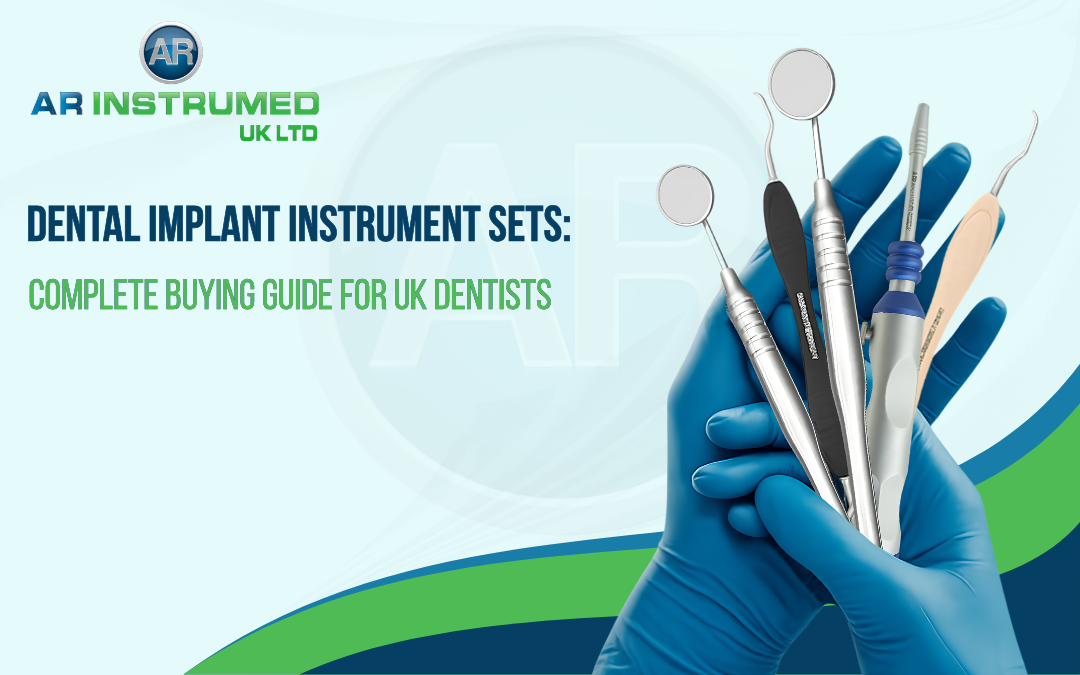
Choosing the right dental implant instrument set is one of the most practical decisions a dental practice will make. The instruments you use directly affect surgical precision, procedure time, sterilization workflow and, ultimately, patient outcomes. Yet many clinics still buy instruments reactively replacing worn tools one at a time instead of thinking through what a complete, well-organized set should actually contain.
This guide walks through what belongs in a dental implant surgery kit, how to judge instrument quality, and when it makes more sense to buy a complete set versus individual pieces.
What Is a Dental Implant Instrument Set?
A dental implant instrument set is a curated collection of surgical tools designed to cover every stage of implant placement from soft tissue reflection through to final implant seating. Rather than sourcing each instrument separately, practices use organized sets so the full toolkit is sterilized, stored and presented together on a single tray.
Organized sets exist for a simple reason: implant surgery has a defined sequence of steps, and each step needs a specific instrument. Having that sequence pre-arranged on a tray reduces chairside searching, keeps instruments accounted for during sterilization, and helps maintain a consistent, repeatable protocol across operators in the same practice.
What Instruments Are Included in a Dental Implant Surgery Kit?
A typical implant instrument set draws from several instrument categories, each serving a distinct role in the procedure:
- Implantology instruments — the core tools used specifically for implant site preparation and placement.
- Periosteal elevators — used to reflect the mucoperiosteal flap and expose the underlying bone.
- Bone scrapers — collect autogenous bone particles for grafting during the same procedure.
- Graft carriers — transport and place bone graft material precisely at the surgical site.
- Implant hammers and mallets — apply controlled force for osteotome techniques and implant seating.
- Membrane instruments — position and adapt barrier membranes used in guided bone regeneration.
- Osteotomes — prepare and expand the osteotomy site, particularly in softer bone.
- Surgical instruments — general-purpose tools such as scalpel handles, forceps and needle holders.
- Measuring instruments — depth gauges and probes that confirm osteotomy depth and angulation.
- Retractors — hold soft tissue clear of the surgical field for visibility and access.
- Suction instruments — keep the field clear of fluid and debris throughout the procedure.
- Implant instrument trays — the cassette or tray system that houses and organizes the full set.
Each of these categories is available individually through AR Instrumed’s Implantology range, so practices can either buy a complete set or build one out piece by piece.
Essential Dental Implant Instruments for Implant Surgery
While a full kit covers every stage of treatment, a handful of instruments do the most work during a typical case.
Periosteal elevators are usually the first instrument used, giving the surgeon clean access to bone without excessive tissue trauma. Once the site is exposed, measuring instruments confirm depth and angulation before drilling begins a step that’s easy to overlook but critical for implant positioning. Osteotomes come into play where bone density is lower, allowing controlled expansion rather than removal of bone. For cases involving grafting, bone scrapers and graft carriers work together: the scraper harvests particulate bone locally, and the carrier places it accurately at the defect site. Retractors and suction instruments run throughout the procedure, supporting visibility and a dry field rather than performing a single discrete step.
Together, these instruments form the backbone of most implant protocols, regardless of the specific system or brand of implant being placed.
Dental Implant Instrument Set vs Individual Instruments
Not every practice needs to buy a full set outright. The right choice depends on where a clinic is in its implant workflow.
A complete set makes sense when:
- The practice is newly offering implant treatment and has no existing instrumentation.
- Multiple operators need identical, standardized kits.
- The clinic wants a single, traceable tray for sterilization and stock control.
Individual instruments make sense when:
- One or two specific tools have worn out or been damaged.
- The practice wants to expand an existing tray with an additional instrument type (for example, adding graft carriers to a set that didn’t originally include them).
- A specific procedure requires a non-standard instrument not included in the base set.
In practice, most established clinics do both they purchase a complete set initially, then top it up with individual instruments as their case mix evolves.
What Should You Look for When Buying Implant Instruments?
Instrument quality has a direct effect on how a set performs over years of clinical use, not just on day one. Key factors to evaluate include:
- Stainless steel quality — the grade of steel affects strength, edge retention and resistance to wear.
- Precision manufacturing — tight tolerances matter for instruments like osteotomes and measuring probes, where small inaccuracies affect surgical outcomes.
- Ergonomic handles — reduce hand fatigue during longer procedures and improve tactile control.
- Instrument durability — instruments should withstand repeated autoclave cycles without degrading.
- Sterilization compatibility — check that instruments are rated for standard autoclave protocols used in UK practices.
- Corrosion resistance — poor-quality steel can pit or discolour after repeated sterilization, which compromises both function and hygiene.
- Tip design — working ends need to match the intended tissue or bone contact precisely.
- Instrument finish — a consistent, high-quality finish reduces the risk of surface defects that harbour debris.
- Procedure-specific requirements — some systems and techniques call for specialized instrument geometry.
- Manufacturer quality — established manufacturers with clinical-grade production standards offer more consistency across a full set.
How to Choose the Right Implant Instrument Set for Your Dental Practice
Selecting a set isn’t just about picking the biggest kit available. A few practical questions help narrow the decision:
- What types of implant procedures do you perform? Straightforward single-tooth placements need a different instrument mix than full-arch or grafting cases.
- How many operators will use the set? Multiple clinicians may need duplicate trays rather than one shared set.
- Which instruments do you already have? Avoid duplicating tools you already own in good condition.
- How is your set configured? Cassette-based organization is easier to audit than loose trays.
- What does your sterilization workflow look like? Instrument count and tray design should fit your existing autoclave and packaging process.
- How often will instruments need replacing? High-use tools like elevators and osteotomes wear faster than retractors.
- What’s your budget? A complete set is often more cost-effective per instrument than buying everything separately.
- Does the manufacturer offer ongoing support? Access to replacement parts and individual instruments extends the life of the whole set.
Lorem ipsum dolor sit amet, consectetur adipiscing elit. Ut elit tellus, luctus nec ullamcorper mattis, pulvinar dapibus leo.
Stainless Steel Dental Implant Instruments: Why Material Quality Matters
Stainless steel remains the standard material for dental implant instruments, but not all stainless steel is equivalent. High-quality stainless steel dental instruments are manufactured to resist corrosion through hundreds of sterilization cycles, hold a sharp or precise working edge, and maintain structural integrity under repeated mechanical stress.
Lower-grade steel may look identical on delivery but degrade faster — developing surface corrosion, dulling more quickly, or becoming brittle. For high quality dental implant instruments, this comes down to the steel grade used, the heat treatment and finishing process, and the manufacturer’s quality control standards. This is particularly important for instruments that experience direct mechanical load, such as osteotomes and bone scrapers, where material fatigue has a real clinical consequence.
Complete Implant Set or Build Your Own Tray?
Complete Set
- Faster setup for new implant services
- Standardized instrumentation across the practice
- Easier tray organization and sterilization tracking
- Convenient starting point for new practices entering implantology
Individual Instruments
- Replace specific worn or damaged instruments
- Customize a set for particular procedures or techniques
- Expand an existing tray as case complexity grows
- Avoid purchasing tools the practice doesn’t actually use
Neither approach is inherently better — the right path depends on whether you’re building a workflow from scratch or refining one that already exists.
Where to Buy Dental Implant Instruments in the UK?
For UK dental practices, laboratories and distributors, sourcing instruments from a manufacturer that understands clinical requirements rather than a generic supplier makes a measurable difference in instrument longevity and consistency.
AR Instrumed UK manufactures and supplies dental instruments, including a dedicated Implantology range covering complete instrument sets as well as individual pieces across every category discussed above.
Why Choose AR Instrumed UK?
- Professional dental instruments manufactured to clinical standards
- A dedicated Implantology range covering full procedural needs
- Stainless steel instruments built for durability and corrosion resistance
- Both individual instruments and complete sets available
- Precision manufacturing with consistent tolerances
- Custom instrument solutions for specific practice requirements
- UK-based contact and support for practices and distributors
- Suitable for dental professionals, clinics, laboratories and distributors
Frequently asked question
What instruments are needed for dental implant surgery?
A typical procedure requires periosteal elevators, measuring instruments, osteotomes, retractors, suction instruments and general surgical tools, with bone scrapers, graft carriers and membrane instruments added for grafting cases.
What is included in a dental implant instrument set?
Most complete sets include implantology-specific instruments, elevators, retractors, measuring tools, surgical instruments and an organized tray or cassette to house them.
What is the best material for dental implant instruments?
High-grade stainless steel is the standard, chosen for its corrosion resistance, durability and ability to withstand repeated sterilization cycles.
Should I buy an implant instrument set or individual instruments?
New practices or those standardizing across multiple operators generally benefit from a complete set. Established practices topping up or replacing specific tools can buy individual instruments instead.
Where can I buy dental implant instruments in the UK?
AR Instrumed UK manufactures and supplies both complete implant instrument sets and individual instruments for dental practices, laboratories and distributors across the UK.
How should dental implant instruments be sterilized?
Implant instruments should be cleaned and sterilized following standard autoclave protocols, with attention to manufacturer guidance on cycle compatibility to preserve instrument finish and longevity over time.